Custom Notifications with 'gdbus call' + 'wired-notify'
I wanted to write this short guide on the functionality of gdbus call as I
couldn’t find any resources online regarding it besides its own documentation.
I’ll also quickly cover my wired-notify config, since it’s a really neat
notification daemon that I don’t think is nearly popular enough :)
Here’s the reason I went through this trouble, first off: a tiny configurable volume HUD that live-updates in place as you change the device volume.
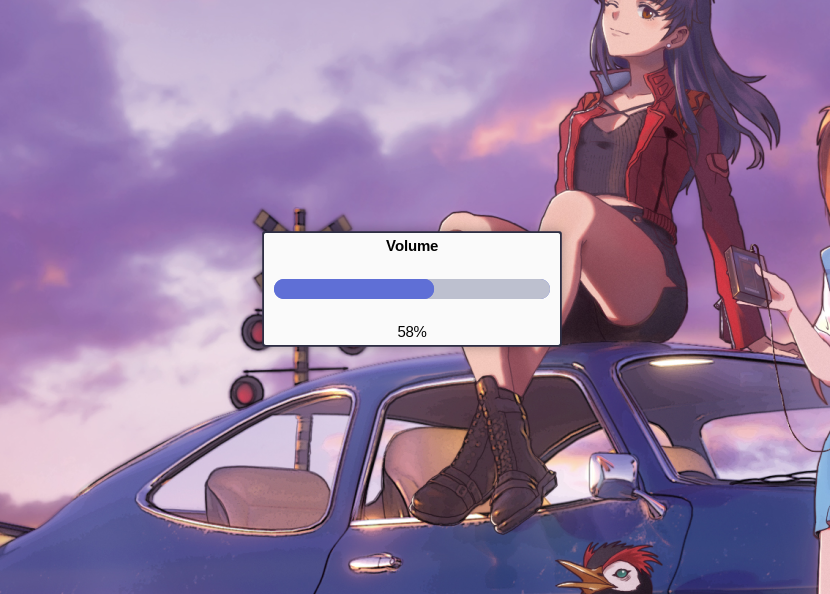
Although gdbus call has many use-cases, the one I’ll focus on here is
sending custom notifications, as notify-send doesn’t expose many of the
properties I needed to set. notify-send, along with other notification
frameworks I looked at, didn’t support updating existing notifications using
identifiers. gdbus call does allow this granular control, along with exposing
some other cool properties.
Syntax
gdbus call
  --session
  --dest org.freedesktop.Notifications
  --object-path /org/freedesktop/Notifications
  --method org.freedesktop.Notifications.Notify
  --
  "identifier"
  "1"
  ""
  "Notification title"
  "Notification description"
  "[]"
  "{}"
  "4000"
Running this will return (uint32 1,), the ‘1’ representing the notification’s
unique identifier. This is useful if you want to parse that identifier and
re-use it later; one way to do so would be using sed (e.g., sed 's/[^ ]* //; s/,.//' would strip everything but the identifier).
A few other tips:
--sessionrepresents the user’ssystemd --userinstance--dest,--object-path, and--methodin this case are all used to point tofreedesktop.notifications.notify, and the following parameters are specified in freedesktop’s documentation- The ‘1’ represents the identifier, and the replaces ID
- The following blank string is the notification icon
- The following two strings are for the Summary (notification title) and Body (multi-line description)
- The empty array is for actions, for ex, sending a callback to the application when clicked
- The empty dictionary is for hints; these are used to send extra data such as (in my use case) the current volume level, an image, extra text, etc
- The ‘4000’ represents the expiration timeout in ms. If set to -1, it falls back to the notification server’s default
Body text
The body text can, in most cases, contain limited markup:
<b>...</b>for bold,<i>...</i>for italics,<u>...</u>for underlines,<a href="...">...</a>for links, and<img src="..." alt="...">for images
Providing hints
Hints are provided as a dictionary, using the following format:
{'Name': <'type':'value'>}
So, for example, sending a hint for the integer value of my volume notification looks like:
{'value': <58>}
And for providing a file path for an image preview:
{'image-path': <'file:///dir/image.jpg'}
Note that when providing the dictionary in the command, it should be encased by double-quotes.
That’s all there is to it! I hope this comes in handy for someone at some point :)
More configs
Finally, if you’re curious, here’s my wired-notify config, as well as the simple script I call on volume update to send a notification to it:
(
    max_notifications: 4,
    timeout: 10000,
    poll_interval: 16,
    history_length: 20,
    replacing_enabled: true,
    replacing_resets_timeout: true,
    min_window_width: 300,

    debug: false,
    debug_color: Color(r: 0.0, g: 1.0, b: 0.0, a: 1.0),
    debug_color_alt: Color(r: 1.0, g: 0.0, b: 0.0, a: 1.0),

    layout_blocks: [
        (
            name: "root",
            parent: "",
            hook: Hook(parent_anchor: TM, self_anchor: TM),
            offset: Vec2(x: 0.0, y: 40.0),
            render_anti_criteria: [Progress],
            params: NotificationBlock((
                monitor: 0,
                border_width: 0,
                border_rounding: 8,
                background_color: Color(hex: "#99000000"),
                border_color: Color(hex: "#99000000"),
                border_color_low: Color(hex: "#99000000"),
                border_color_critical: Color(hex: "#99000000"),
                border_color_paused: Color(hex: "#99000000"),
                gap: Vec2(x: 0.0, y: 12.0),
                notification_hook: Hook(parent_anchor: BL, self_anchor: TL),
            )),
        ),

        (
            name: "image",
            parent: "root",
            hook: Hook(parent_anchor: TL, self_anchor: TL),
            offset: Vec2(x: 0.0, y: 0.0),
            params: ImageBlock((
                image_type: Hint,
                padding: Padding(left: 6.0, right: 2.0, top: 6.0, bottom: 6.0),
                rounding: 6.0,
                scale_width: 64,
                scale_height: 64,
                filter_mode: Lanczos3,
            )),
        ),

        (
            name: "summary",
            parent: "image",
            hook: Hook(parent_anchor: MR, self_anchor: BL),
            offset: Vec2(x: 0.0, y: 0.0),
            params: TextBlock((
                text: "%s",
                font: "Arial Bold 11",
                ellipsize: End,
                color: Color(hex: "#F3F3F3"),
                color_hovered: Color(hex: "#DEDEDE"),
                padding: Padding(left: 8.0, right: 8.0, top: 6.0, bottom: 2.0),
                dimensions: (width: (min: 280, max: 280), height: (min: 0, max: 0)),
            )),
        ),

        (
            name: "body",
            parent: "summary",
            hook: Hook(parent_anchor: BL, self_anchor: TL),
            offset: Vec2(x: 0.0, y: -3.0),
            params: ScrollingTextBlock((
                text: "%b",
                font: "Arial 11",
                color: Color(hex: "#F3F3F3"),
                color_hovered: Color(hex: "#DEDEDE"),
                padding: Padding(left: 8.0, right: 8.0, top: 2.0, bottom: 6.0),
                width: (min: 150, max: 250),
                scroll_speed: 0.1,
                lhs_dist: 35.0,
                rhs_dist: 35.0,
                scroll_t: 1.0,
            )),
        ),

        (
            name: "rootProgress",
            parent: "",
            hook: Hook(parent_anchor: MM, self_anchor: MM),
            offset: Vec2(x: 0.0, y: 0.0),
            render_criteria: [Progress],
            params: NotificationBlock((
                monitor: 0,
                border_width: 0,
                border_rounding: 8,
                background_color: Color(hex: "#99000000"),
                border_color: Color(hex: "#99000000"),
                gap: Vec2(x: 0.0, y: 12.0),
                notification_hook: Hook(parent_anchor: BL, self_anchor: TL),
            )),
        ),
        (
            name: "progressBlock",
            parent: "rootProgress",
            hook: Hook(parent_anchor: TM, self_anchor: TM),
            offset: Vec2(x: 0.0, y: 0.0),
            params: ProgressBlock((
                padding: Padding(left: 12.0, right: 12.0, top: 12.0, bottom: 12.0),
                border_width: 0.0,
                border_rounding: 10.0,
                fill_rounding: 10.0,
                border_color: Color(hex: "#F3F3F3"),
                background_color: Color(hex: "#99000000"),
                fill_color: Color(hex: "#F3F3F3"),
                width: 276.0,
                height: 20.0,
                border_color_hovered: Color(hex: "#F3F3F3"),
                background_color_hovered: Color(hex: "#99000000"),
                fill_color_hovered: Color(hex: "#F3F3F3"),
            )),
        ),
        (
            name: "progressSummary",
            parent: "progressBlock",
            hook: Hook(parent_anchor: TM, self_anchor: BM),
            offset: Vec2(x: 0.0, y: 0.0),
            params: TextBlock((
                text: "%s",
                ellipsize: NoEllipsize,
                font: "Arial Bold 11",
                color: Color(hex: "#F3F3F3"),
                color_hovered: Color(hex: "#DEDEDE"),
                padding: Padding(left: 0.0, right: 0.0, top: 6.0, bottom: 12.0),
                dimensions: (width: (min: 0, max: 300), height: (min: 0, max: 0)),
            )),
        ),

        (
            name: "progressBody",
            parent: "progressBlock",
            hook: Hook(parent_anchor: BM, self_anchor: TM),
            offset: Vec2(x: 0.0, y: 0.0),
            params: TextBlock((
                text: "%b",
                font: "Arial 11",
                ellipsize: NoEllipsize,
                color: Color(hex: "#F3F3F3"),
                color_hovered: Color(hex: "#DEDEDE"),
                padding: Padding(left: 0.0, right: 0.0, top: 12.0, bottom: 6.0),
                dimensions: (width: (min: 0, max: 300), height: (min: 0, max: 0)),
            )),
        ),
    ],
)
#!/usr/bin/env perl
## The sink should be the default
my $sink = `pactl get-default-sink`;
## Run pactl and store output
open(my $fh, '-|', 'pactl list sinks');
## Set the record separator to consecutive newlines (same as -000)
$/="\n\n";
while (<$fh>) {
if (/Name:.$sink/) {
## Extract the current volume
/Volume:.*?(d+)%/;
my $volume=$1;
## Send the notification, using gdbus so we can specify the
## ID to update on repeat
exec "gdbus call --session --dest org.freedesktop.Notifications --object-path /org/freedesktop/Notifications --method org.freedesktop.Notifications.Notify 'identifier' '999' '' 'Volume' '$volume%' '[]' '{"value": <$volume>}' '4000'";
}
}